
” Bravest are those who love unconditionally and never expect anything in return ” . This must be true in case of Daagh Dehlvi. He lived a life of pain and separation and left behind pieces of Urdu Poetry never experienced by anyone before. “
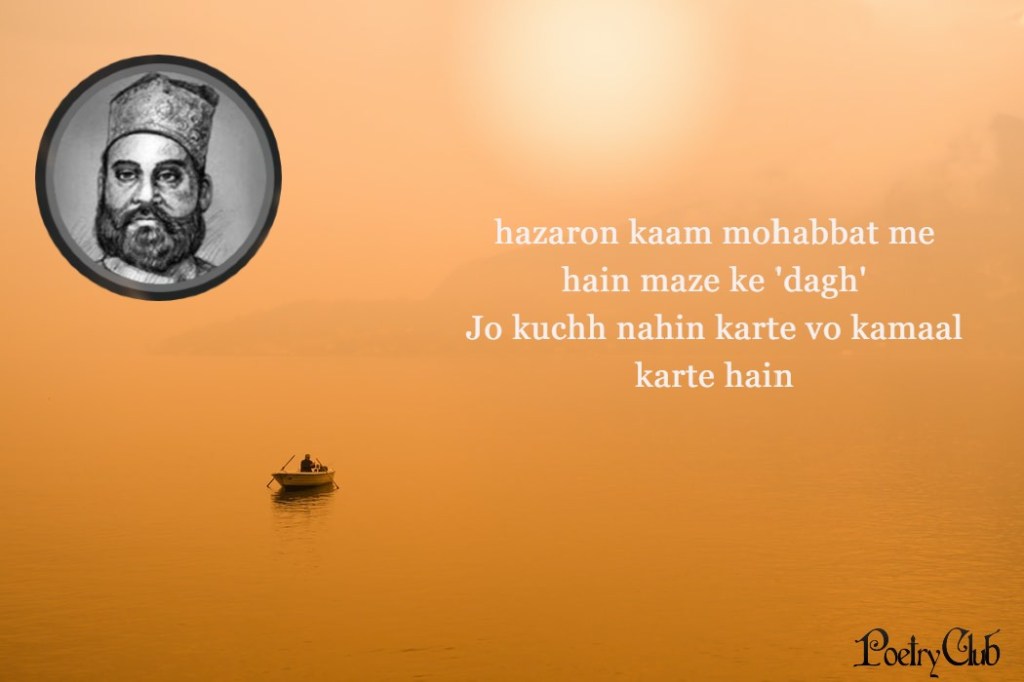
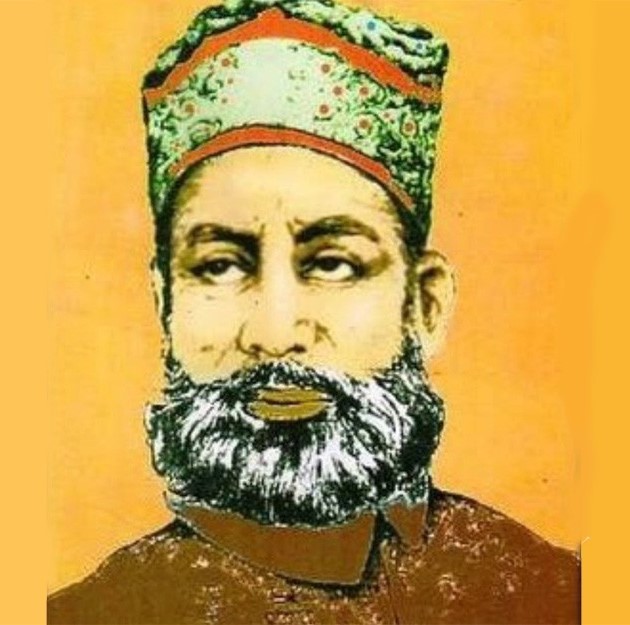
Nawaab Mirza Khan Daagh Dehlvi was a marvellous Mughal poet known for his romantic Urdu ghazals focussing on his first love and the pangs of separation thereafter. He wrote romantic and sensuous poems and ghazals in simple and chaste Urdu, minimising the usage of Persian words. He took the pen name Daagh Dehlvi ( where Daagh is an Urdu word referring to stain or grief while Dehlvi means someone who belongs to Delhi). This refers to the fact that he belonged to the Delhi school of thought.
Dehlvi was born on 25 May 1831 in Chandni Chowk, Delhi. His mother remarried the Mughal crown prince, Mirza Muhammad Fakhroo when Dehlvi was just 4. He had the privilege of being educated by the poet laureate Mohammad Ibrahim Zauq in the Delhi Red Fort. Later he was also tutored by Ghalib on finer nuances of Urdu Literature and poetry. Belonging to the Dabistan-e-Delhi (Delhi school of thought) he never allowed the western influences mar his way of writing. Just at the age if 10 he had started writing ghazals. His simple style was something that made him reachable. After Fakhroo’s death, he moved to Rampur under the aegis of Nawab of Rampur, Yusuf Ali Khan Bahadur. This marks the beginning of his love life and for us the birth of passionate Daagh who redefined Love and belonging in a simple and provoking manner.
He came across a beautiful young courtesan from Kolkata named Munni Bai at Benazir Palace during the annual fair at Rampur. Daagh and Munni Bai fell for each other. Inflamed in love he said:
ishq nemat hai aadmi ke liye,
ishq jannat hai aadmi ke liye.
dil isi se jawaan rehta hai,
marmiton ka nishaan rehta hai.
ishq eemaan hai khuda rakkhe,
ye meri jaan hai, khuda rakkhe.
Munni Bai was also a poet who wrote with the pen name Hijaab (meaning veil). After the fair ended the two separated but promised to stay connected to each other through letters. The letters the two exchanged during these days of courtship are said to be testaments of pure love while focussing adequately on the pangs of separation ( Hijr ). Daagh wrote :
aa gayi hijr ki ghadi sar par
ye balaa jhelni padi sar par
hasrat aalood wo nigaahein thi
sharar aamez meri aahein thin
rasm-e-ulfat ke ho gaye iqraar
khat kitaabat ke ho gaye iqraar
Munni bai’s reply to the same showed the desperation on her part too as she writes:
jee nahin chaahta hai jaane ko
par chale hain qalaq uthhaane ko
hum to bhooke hain aadmiyat ke
aadmiyat ke saath ulfat ke
aise waison se jee nahi milta
daagh sa aadmi nahi milta
‘Hijaab’
The bond that they both shared amongst each other was definitely unique, however, Daagh always had this complaint with her that she wasn’t frequent enough in her replies. He said in one of his letters that he would consume poison and die if she didn’t reply frequently. Daagh was invited by Munni to Kolkata. The two stayed together for 3 months opposite the famous Nakhoda Masjid in Kolkata but then had to separate yet again. Daagh mentioned :
kisi karwat se kal nahin aati
nahin aati ajal nahin aati
jee bahalta nahin kisi surat
dum nikalta nahin kisi surat
dil se pehroon kalaam karta hoon
zindagi ko salaam karta hoon
The death of the Nawab of Rampur in 1887 changed the course of this beautiful courtship. Daagh became a wanderer before finally getting settled in Hyderabad. Years later on his visit to Kolkata with the Nizam of Hyderabad, he came to know that Munni Bai had married a Maulvi. He was heartbroken and wrote a letter to her asking her to return.
“Bai ji, ghazab to yeh hai ki door baithi ho. Pass hoti to ser hoti.Tumhaare ird ghumta aur sholay jwaala ban jaata. kabhi tumhe shama karaar deta aur pataanga ban ke parwaan ho jaata. Main tumhaare liye bilbilaa raha hu. yeh khaufnaak kaali kaali raatein aur tanhaai.”
He always respected Munni Bai and never imposed his wills on her. After she declined his offer and refused to be with him , He wrote :
aap ka etibar kaun kare
roz ka intizar kaun kare
zikr-e-mehr-o-vafa to hum karte
par tumhe sharmsar kaun kare
ho jo us chashm-e-mast se be-khud
phir use hoshiyar kaun kare
tum to ho jaan ek zamane ki
jaan tum par nisaar kaun kare
hijr me zahar kha ke mar jaun
maut ka intizaar kaun kare
tumhara dil mire dil ke barabar ho nahin sakta
vo shisha ho nahin sakta ye patthar ho nahin sakta
Time passed and Daagh decided to let go his first love forever. Some decades down the line, Munni came to Hyderabad to meet Daagh. Daagh, seventy, was still not over her. He was ready to accept her as he always needed a companion with him. Daagh’s well-wishers made him believe that she was more interested in his wealth and Daagh turned her away. The love that spread across two decades transformed into hatred.
haaye jeete hain hum na marte hain
kis qayaamat ke din quzarte hain
khana-i-aish lut gaya kaisa
mujh se maashooq chhut gaya kaisa
raat din jee rahe hain mar kar hum
sohbat-e-yaar ho gayi barham
ya ilaahi nijaat gham se mile
wo saraapa hijab hum se mile
warna us ka khayal bhi na rahe
ab hai jaisa ye haal bhi na rahe
Daagh’s romantic life has had a great impact on his ghazals and poetry. His famous ghazal “Saaz ye kina saaz kya jaane” is a testimony to that. His style was definitely unique in terms of his love for Urdu. As was commonly seen in a lot of shayars of the Delhi School, Daagh too loathed excessive Persian usage in his shayari. He says:
“Urdu hai jiska naam hamee jaante hai…Daagh Hindustaan mein dhoom humaari zubaan ki hai”
He died in 1905 at the age of 74 in Hyderabad after a paralytic stroke. His mortal remains were laid to rest at a dargah in Hyderabad itself. He has left behind a rich legacy for many to follow. Daagh’s poetry reminds us a tale of unselfish pious love that crossed all boundaries of society . The love that belongs to heaven and the pain that made Daagh immortal through his work.
khabar sun kar mire marne ki vo bole raqibon se
khuda bakhshe bahut si khubiyaan thin marne vaale me
Concept and Text : Bhavya Shandilya and Sanskar Jhajharia
 Poetry Club's Blog
This is a beautiful piece. It’s lamentable how many of us have remained ignorant of great ghazal writers. Feels good to learn about their lives and what inspired their writings. It’s great what you guys are doing.
Keep it up!
LikeLiked by 1 person
Thank you! We’ll be putting out many such posts and more so please stay tuned! Abhi bas shuruaat hai, abhi to urdu jubaan ka ishq sar chadke bolega 🙂
LikeLike